Jenny Kurtz
Thirteen Reasons WhyJenny Kurtz is a cheerleader at school whose appearances in Hannah Baker’s account trace a painful arc from uncomplicated excitement over Hannah’s date to an act of care shadowed by a fatal consequence. First presented on the tapes without a name, Jenny is later identified through the silence that overtakes her when she learns Hannah is dead. Her role is small in duration but pivotal in effect: she is kind to Hannah, and her attempt to help becomes entangled with the accident that kills a driver.
Identity and Introduction
Jenny first appears as the unnamed cheerleader Hannah describes after agreeing to meet a boy at Rosie’s Diner. She slaps her hands on the counter, eager to brag about the date, and Hannah asks her to keep it secret until the next day. Jenny agrees, while asking Hannah to promise that she will later tell her every detail. Hannah stresses that the cheerleader was sweet and excited for her, and did nothing wrong. The warmth of the exchange is notable because Hannah takes care to defend Jenny against suspicion even as the tape delays revealing who she is.
The delayed identification is part of how Hannah tells the story. At first she claims not to be naming the cheerleader; later, remembering the day the school learned of Hannah’s death, she says she is certain the girl was Jenny Kurtz, her Biology classmate. The reader encounters Jenny’s identity not through a direct introduction but through a retrospective link between two scenes: the friend who had wanted to hear about Hannah’s date, and the student who cannot remain in class when she hears Hannah is dead.
Concern and Distance
Hannah and Jenny’s exchange about Rosie’s is marked by affection and trust. Jenny wants to celebrate Hannah’s date and hear what happened afterward; Hannah, in turn, makes the promise to keep the news quiet until the next day. The scene establishes Jenny as someone who responds enthusiastically to Hannah’s good news, rather than as one of the people Hannah portrays as deliberately cruel. Hannah’s explicit insistence that Jenny did nothing wrong preserves that distinction even as the story later assigns Jenny a consequential part in the chain of events.
After what happens at Rosie’s, Hannah does not tell Jenny about it. Instead, Hannah says she avoids her for as long as she can. The contrast between Jenny’s request to hear every detail and Hannah’s withdrawal matters: the conversation that might have opened into confidence is interrupted by Hannah’s choice to keep the experience to herself. The tapes announce that Jenny will return under her own name, turning the initial lightness of their exchange into a point of painful suspense.
The Day Hannah Dies
When news of Hannah’s death reaches Biology class, Jenny is holding a scalpel beside an earthworm that has been sliced down the middle and pinned open. She puts down the scalpel, falls into a long, stunned silence, then gets up and walks out without stopping at the teacher’s desk for a pass. Hannah has already heard the news and spends the rest of the day puzzled by Jenny’s reaction. Only in retrospect does she understand the connection: the girl who had been excited for Hannah’s date is Jenny, and the news has visibly overwhelmed her.
Jenny’s departure from class is one of the few direct glimpses of her response to Hannah’s death. The narration gives no explanation from Jenny herself; her dropped scalpel, silence, and abrupt exit carry the scene. Hannah says that, like most people, she had not known of Jenny’s connection to her. The recognition therefore does not establish a previously disclosed intimate relationship. It reveals instead that Hannah mattered to Jenny in ways Hannah did not perceive at the time.
The Accident and Its Consequences
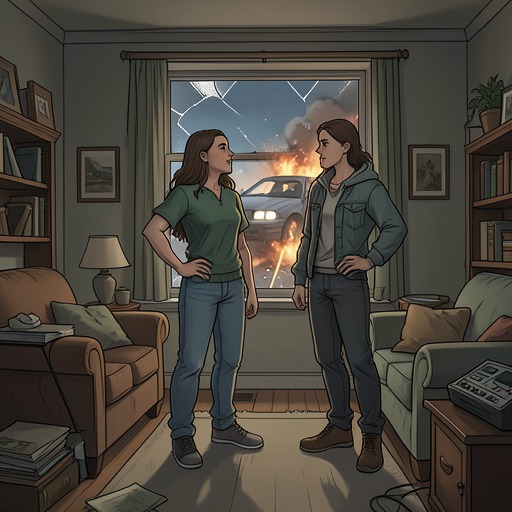
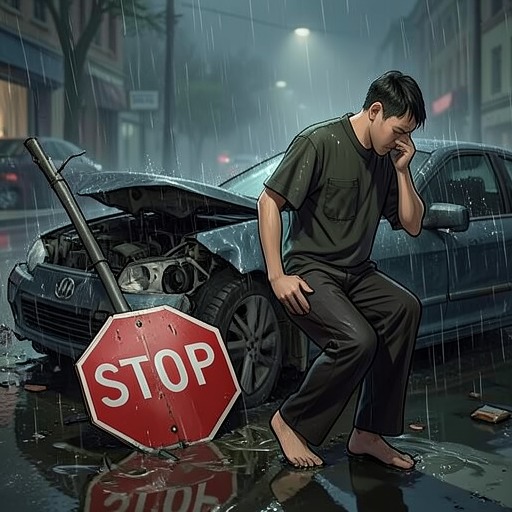
After Hannah leaves a party, Jenny touches her shoulder with a gentle squeeze. Hannah identifies her as the cheerleader from the Student Body office, making this contact the moment that joins Jenny’s earlier kindness to the night’s events. The account does not describe Jenny’s gesture as malicious; it is presented as gentle. But later that night, Jenny’s car strikes a wooden post, and the impact knocks a Stop sign backward in front of the headlights. The sign catches under the car as Jenny screams and brakes, while sparks fly beneath the vehicle as it slides to a stop.
The consequence extends beyond Jenny’s own immediate encounter with the sign. Hannah recalls that the corner was without the Stop sign for part of the night, in the rain, as a pizza delivery driver and another driver approached from opposite directions and one vehicle turned. One of the drivers died. Hannah says Jenny made it home in one piece, but identifies the fallen sign as the consequential problem. Her account links Jenny’s accident to a death through the sign’s absence; it does not present Jenny as intending harm or supply grounds to reduce the chain of events to a simple question of blame.
Narrative Role and Significance
Jenny’s delayed naming makes her a figure of recognition: Hannah first withholds her identity, then retrieves it by remembering the school’s response to her death. That structure makes the classmate’s stunned silence a key to an earlier, unnamed relationship. It also complicates the tapes’ pattern of assigning people a place in Hannah’s story. Jenny is presented as caring, and Hannah explicitly protects her from the implication that she did something wrong, yet the account also shows how an ordinary gesture and a traffic accident can acquire grave consequences through circumstances beyond the gesture’s apparent meaning.
The two images associated with Jenny—the scalpel set down in Biology and the Stop sign displaced beneath her car—frame her part in the narrative through interruption. In the classroom she cannot continue with the dissection after learning Hannah is dead; on the road, the collision leaves a sign out of place and changes what drivers encounter at the corner. Jenny’s significance lies not in a lengthy account of her private life, which the book does not provide, but in this unresolved conjunction of care, limited knowledge, and consequence. Her brief presence makes visible how a person may be important to another without realizing it, and how an action not intended as harm can become part of a fatal sequence.